The Symbolism of Ornaments
Yuri Bezobrazov · · 7 min read
In our previous article we touched on the ornaments used in woodcarving. The symbolism of the ornaments on wooden objects goes back to pagan protective amulets. As Christian culture developed, the symbolism faded and stopped carrying its original meaning, keeping only its outward look. Later it was the image, not its meaning, that passed from generation to generation.
The pagan worldview of the 10th–13th centuries survived in the most culturally closed tribes: the Novgorod Slovenes, the Krivichs, the Vyatichs and the Radimichs. It glorified the life force of nature and, above all, the plant fertility of the earth. The oldest and most widespread group of signs are the symbols of the heavenly bodies. The sun and stars were deified as early as the Bronze Age as patrons of a good harvest and therefore of life as a whole. Two more elements belonged to agrarian symbolism: water, which gives life to the fields, and the sky, which sends this precious, vital water as rain. Water was shown as wavy, rippling or intertwined lines, while the idea of the sky was expressed in the image of birds, the only living creatures that rose into the sky, to the clouds. Birds were seen as intermediaries between the plants of the earth and the clouds that bring rain. Horses drawing the chariot of the sun also appeared among the symbols.
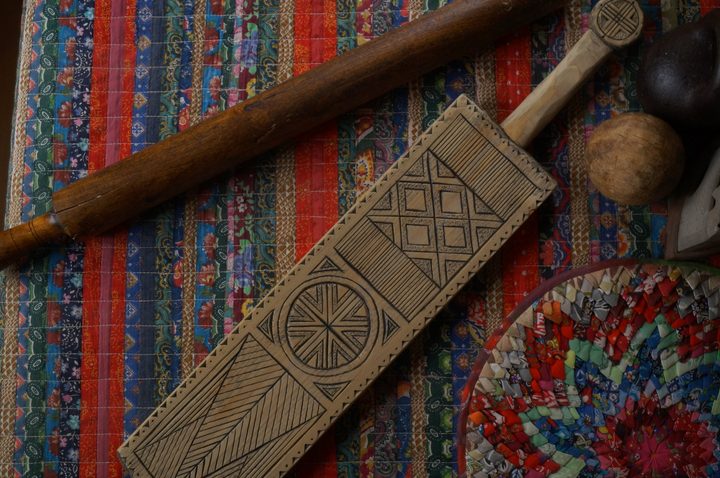
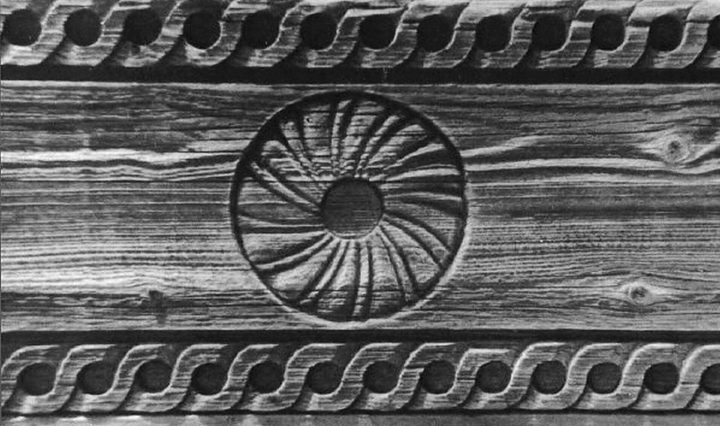
A carved ornament on a rubel (washing beater) made in our workshop after an ethnographic original
Among the symbols of the sun, the cross stands out first of all: it appeared in the ornaments of the ancient Slavs long before Christianity was adopted. The shape of the cross is linked to the most ancient tool for making fire, and at first it was associated with earthly fire, later with heavenly fire. The cross symbolised purification and rebirth — every day the sun returns to the sky, bringing life. Combining the symbolism of fire and the sun, the cross was considered a protective sign that drove away evil spirits. It divided space into 4 parts and guaranteed the wearer of the amulet protection from all four sides.
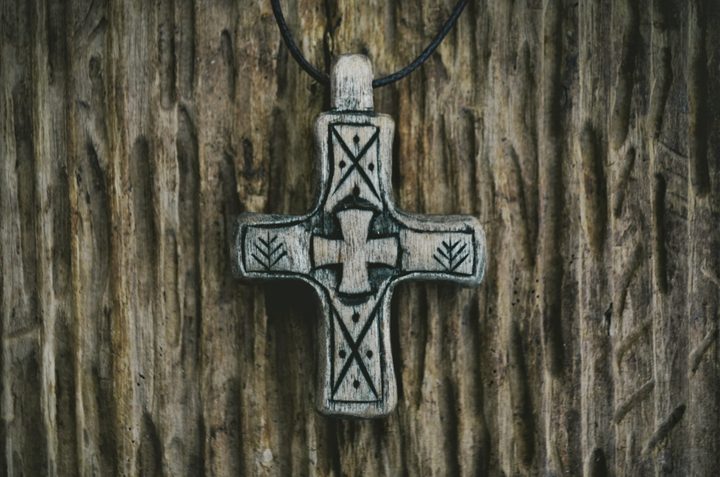
A wooden cross made after a metal pectoral encolpion cross
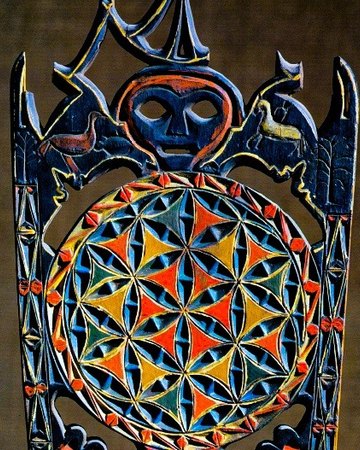
In symbolism the circle is linked to the shape of the solar disc. Together with the cross in a circle, this symbol reflects the link between heavenly and earthly fire. Related to these two elements is the wheel — a many-rayed rather than four-rayed image of the sun moving across the sky. Solar symbols could appear alone or together with the lunar symbol, the crescent moon. In many pagan beliefs this link was seen as the marriage of a man and a woman, with the sun embodying the feminine principle and the moon the masculine. This view was reflected not only in ornaments and amulets but also in carols and wedding songs.
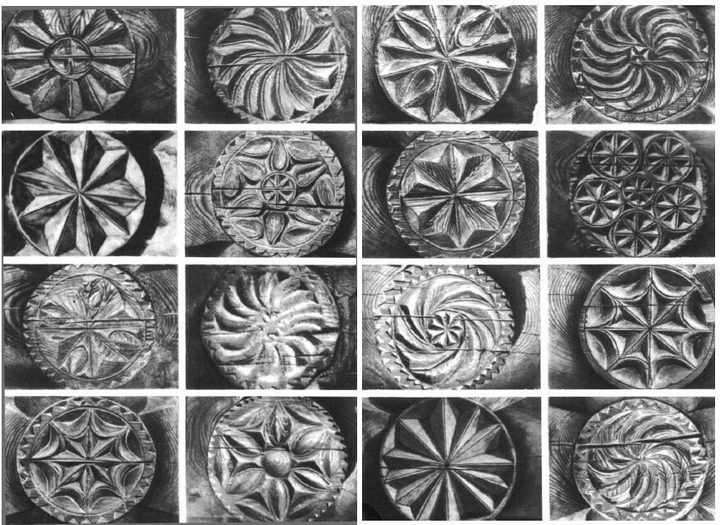
Carved solar rosettes on the main beams of a church
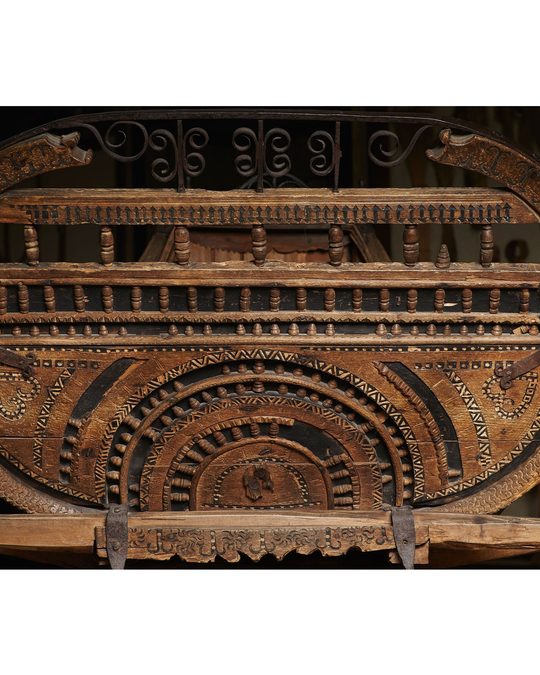
Solar symbols decorated not only the outside of houses (rosettes on the front of the house that served as the centre of the composition) but were also applied to porches, corners and windows, and inside the house. Many wooden household objects were decorated with carving: tableware, chairs, distaffs, benches, tables. This use of ornament originally had a protective meaning: protecting the food, the person using the furniture or the stored grain. The decoration of distaffs unconsciously reflected the myth of the sun's rays as threads wound onto the solar wheel. The link between the distaff and the solar disc explains why all weaving tools were richly decorated with such ornaments.
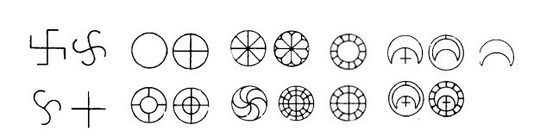
Symbols of the heavenly bodies (V.P. Darkevich, 1960)
The triangle, like the simple rhombus, stood for the earth, the solid ground. A chequered rhombus meant land ready for sowing (often with seed dots), and a rhombus with hooks meant fruitful land. This symbol united the images of the earth, the plant and the woman; it could also symbolise the tree of life. It was depicted on clothing, idols and tableware. Alongside the sun it is an important symbol.
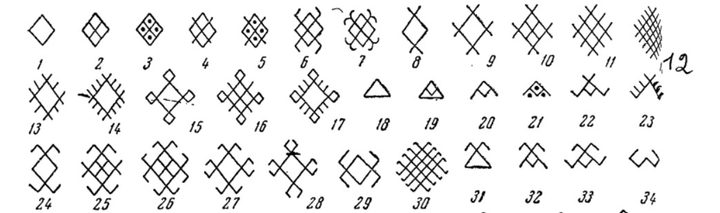
Rhombuses and triangles in symbolism (A.K. Ambroz, 1965)
In our workshop we pay special attention to symbolism when making utensils and household objects. For example, the salt cellar with a horse combines all the main symbols of the “agrarian cycle”: the sun as a wheel and crosses, water as slanting lines and fertile land as a rhombus with a dot. The main advantage of traditional symbolism is the simplicity and graphic quality of the design, which, used correctly, can add meaning to a work.
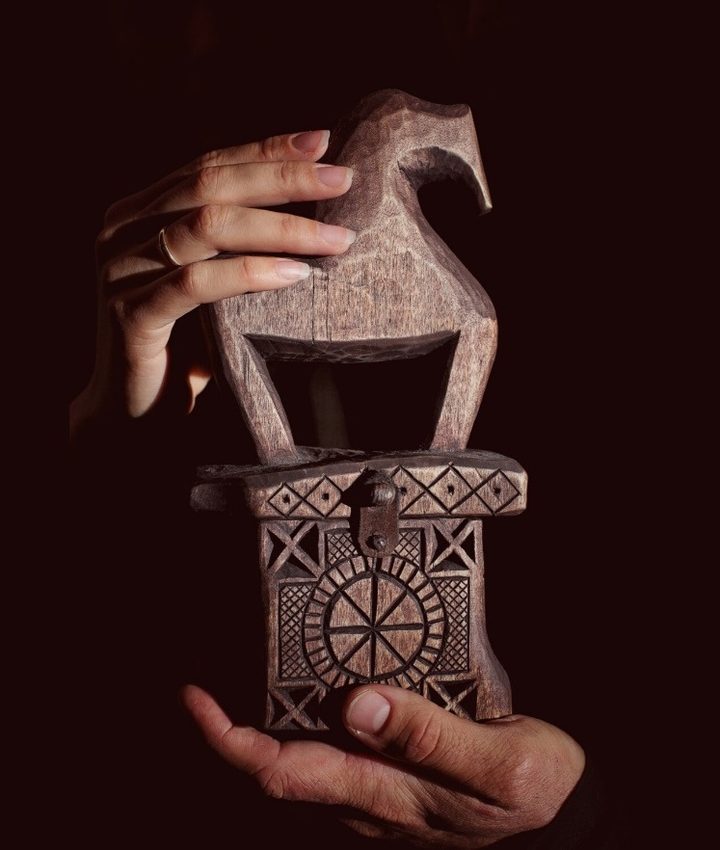
A carved salt cellar with a horse made in our workshop
Symbols matter, but an object will not come alive if they are placed at random. It needs a composition or ornament that is aesthetically harmonious and brings out the lacy quality of the wood. We already looked at such combinations when we described the types of carving. Chip carving, as the most ancient, has two typical types of composition: an open band, like a belt of squares, triangles and rhombuses, and a closed one with a solar rosette in the middle, framed by half-rosettes, squares and triangles. On distaffs a band composition could fill the whole surface of the blade and, for all its compactness, look fresh and striking. Balance matters most in any composition: whirling rosettes made in the notch-and-nail technique seem to spin tirelessly, and only the frame of the circle holds back their unbridled flight. Many objects have an ornament of small triangles along the contour: this emphasises the shape and adds volume. Besides, many patterns have a story or reflect everyday subjects: large rosettes rise smoothly, like the sun, above a quiet ploughed field of rhombuses and squares.
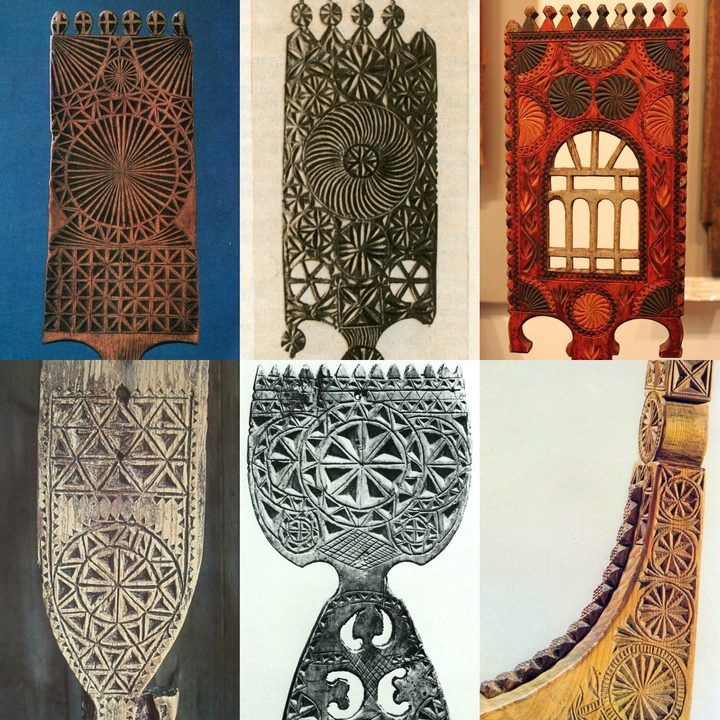
Carved ornaments with rosettes on distaffs
Every element has its place in a pattern: if the master draws or carves birds, they guard the sun. If the image of a tree appears on a distaff, it becomes the main vertical of the work. The perception of the object changes depending on where the image is placed: for example, if the rosette is in the centre or a little higher, the whole composition becomes lighter and seems to reach for the sky — exactly as in the Vologda distaffs mentioned above. The opposite is possible too: on Olonets distaffs the main figures are below the centre, and the whole composition seems to be drawn towards the earth.
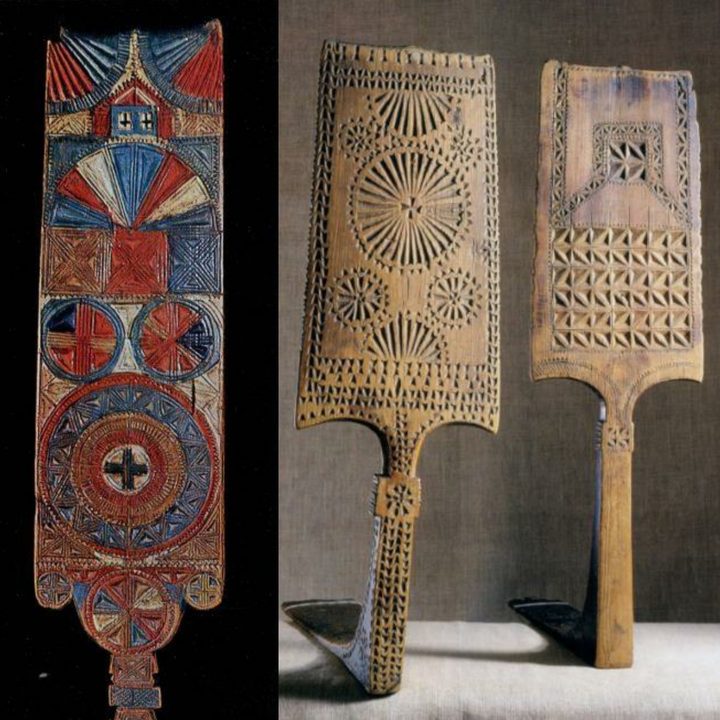
Olonets and Vologda distaffs
Carving was often complemented by painting: it could repeat the same motifs or add something new. Flowers blossomed under the masters' hands, and the strictness of the ornament was lost, but the charm of wood carving remained even then. The art of Russian ornament lies precisely in its easy adaptation, its variety and the simplicity of the elements from which, under the master's knife, an expressive and unique result emerges.
Sources (in Russian)
- Ambroz A.K. (1965) “An Early Agricultural Cult Symbol (the ‘Rhombus with Hooks’)”. Sovetskaya Arkheologiya, no. 3, pp. 14–27.
- Darkevich V.P. (1960) “Symbols of the Heavenly Bodies”. Sovetskaya Arkheologiya, no. 4, pp. 56–67.
- Rybakov B.A. (1971) “Decorative and Applied Art of Rus, 10th–13th Centuries”.
- Taranovskaya N.V. (2001) “Russian Distaffs”.
- https://ornamika.com/pattern/10742/
- Zaitsev B.P., Pinchukov P.P. (1978) “Solar Patterns”.