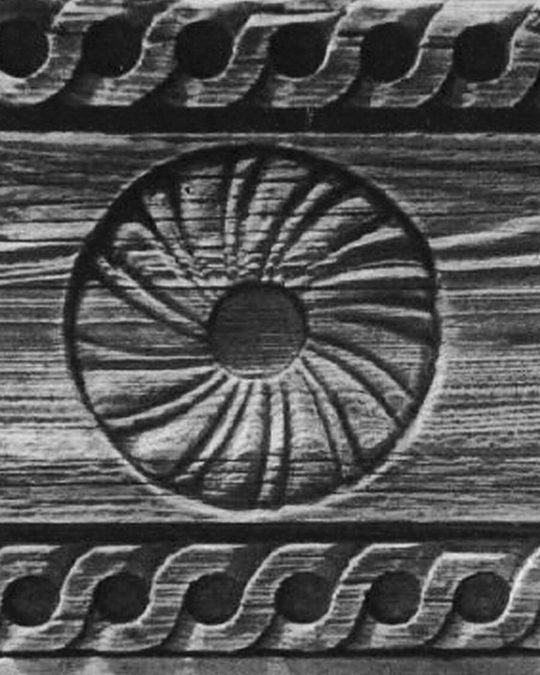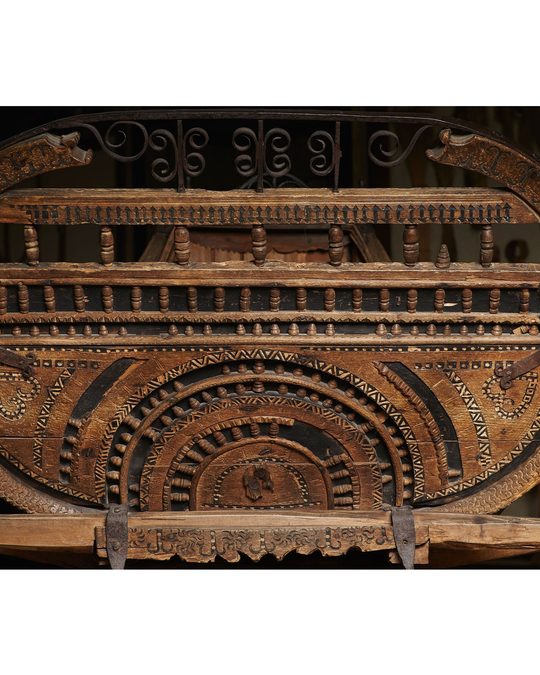
Types of Woodcarving
Yuri Bezobrazov · · 4 min read
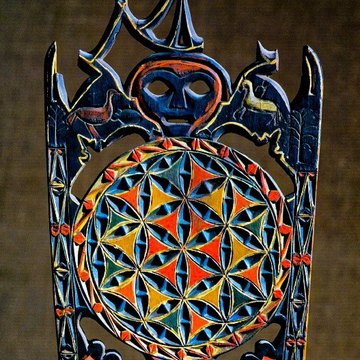
A woodcarver is always a creator. Under his hands a simple log turns into sculptures and tableware, and a three-dimensional picture appears on a flat board. Carving is done in several techniques.
Chip carving
The oldest and most widespread is chip carving. It was the first attempt to bring the calm surface of a board to life and send across it the ripple of the simplest relief ornament, similar to the stamping on clay pottery. The main role in this carving is played by the triangle: to create a design, the master gradually removes small three-sided pyramids from the board. The ornament of chip carving is geometric: either straight or compass-drawn lines. Squares and bands (or belts) made of small rhombuses or triangles appear on the board, often emphasised by contour lines, and circles divided into sectors. Rosettes blossom — circles that dominate the other elements and serve as the centre of the composition. Most often they are radiant, sometimes with a star inscribed in the centre; the whole composition is in one way or another centred on the symbolism of the sun and the movement of the heavenly bodies: so echoes of the pagan meaning of symbols appear in the details. The ornament now has a decorative rather than a ritual function, but its harmony is prompted by the past.
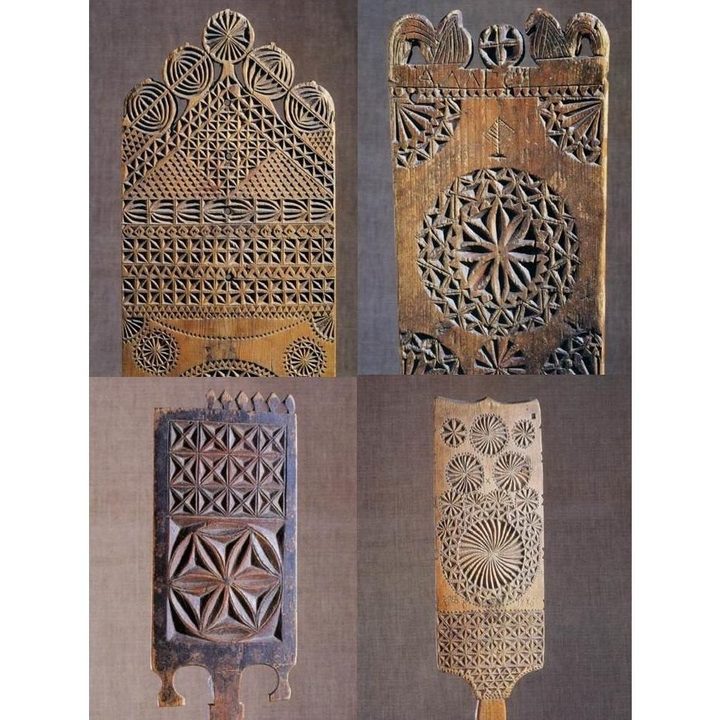
An example of chip carving on distaffs (N.V. Taranovskaya, 2001)
Notch-and-nail carving
Notch-and-nail, or bracket, carving is the next stage in the development of carving as an art and as a craft. Its origin is linked to the appearance of the gouge. It allowed masters to start using crescent-shaped notches in their patterns. This led them to smooth, semicircular lines, and the look of the rosette changed too, coming closer to a flower, and nothing in the four-petalled flower recalled the pagan symbol of the sun. From this moment decoration takes on a decorative character.
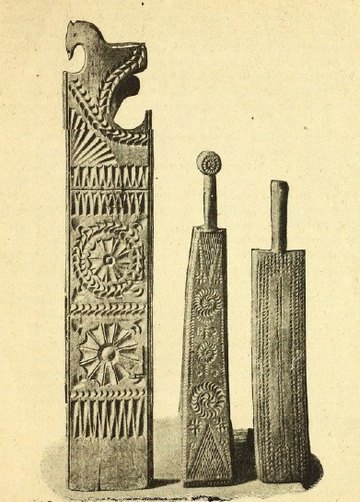
Notch-and-nail carving: part of a loom and rubels (V.S. Voronov, 1925)
Contour carving
Contour carving, which replaced chip carving in its cultural significance, can be called “wooden graphics”: a fine groove, the cut, is made with a knife in two passes. Such lines can intertwine and cross in fanciful ways, and the ease of execution allows great detail: it is almost embroidery in wood. It is thanks to this technique that everyday scenes and more complex patterns and ornaments can be depicted.
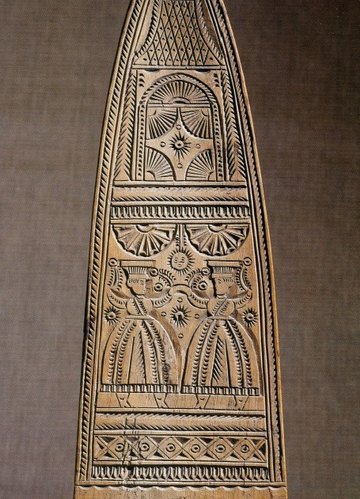
Detail of a “terem” distaff from the Yaroslavl province: notch-and-nail and contour carving (N.V. Taranovskaya, 2001)
Sculptural relief carving
Sculptural relief carving was born at the same time as chip carving, but its motifs are quite different. These are lions, birds and sirens that settled on architectural friezes and ships. It is not a type of carving available to any beginner: it requires more technique, time and experience. The ornament is mostly floral, with twining elements and many rosettes. The ends of the shoots are held firmly by various beasts: what is that if not a fairy-tale lost world?
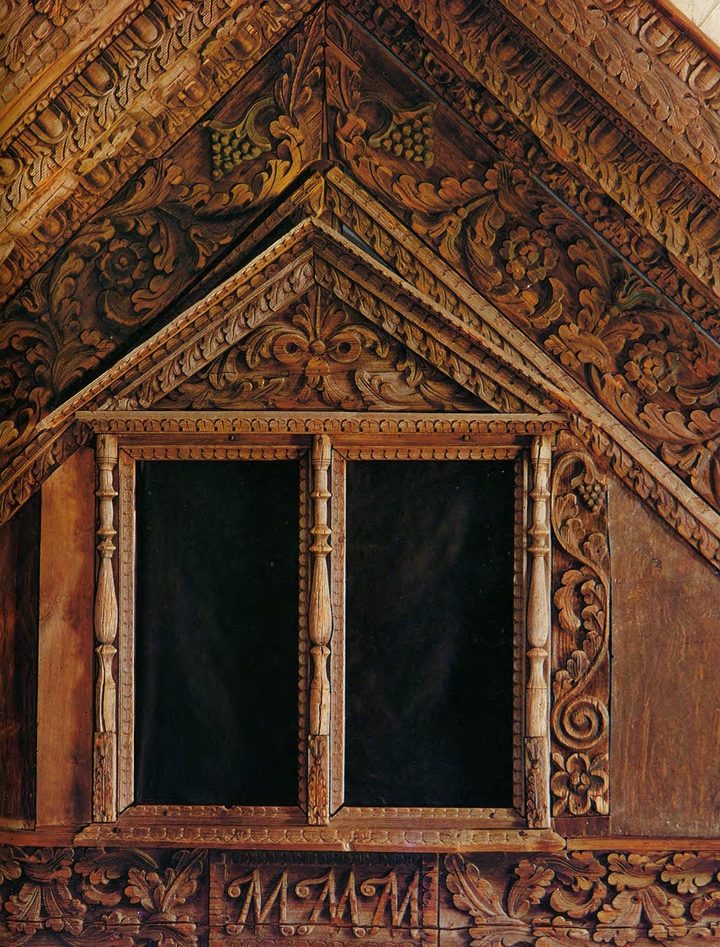
Sculptural relief carving on the gable of a house
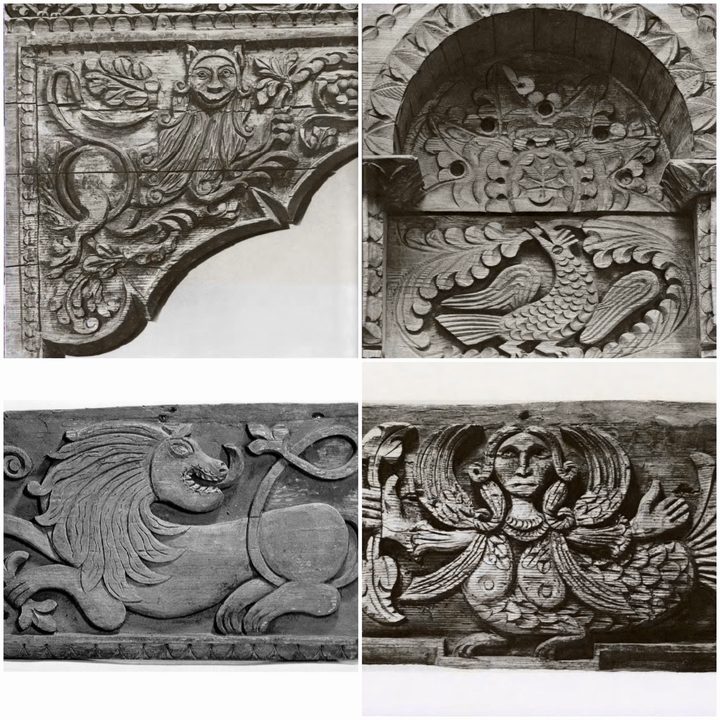
Fragments of fascia boards, the window surround of an upper room and a gate lintel
Flat relief carving
Flat relief carving was invented for practical purposes: it decorated printing blocks that allowed a pattern to be repeated many times on fabric. For a good, clear print the relief must have the greatest possible depth differences: the wood between the elements of the ornament is removed to different depths. Similar in purpose was fine-pattern notch carving, created to ornament gingerbread boards. All the relief was cut with one aim: to give the printed gingerbread a raised surface in the right places, so that after baking the desired relief design would appear.
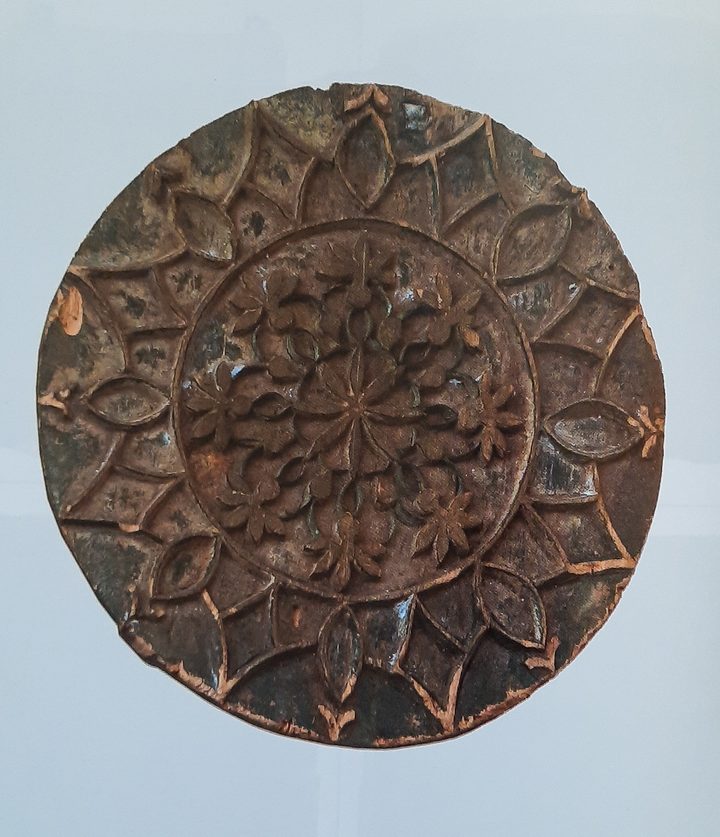
A printing block for shawls
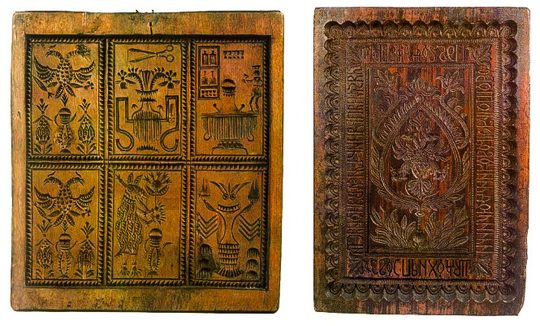
Gingerbread boards in fine-pattern carving
Fretwork
Fretwork stands a little apart. It is used mainly for distaffs and benches, although it can sometimes be seen on other objects as an additional decoration. These are through holes, usually simple in their geometry, but forming a design of their own in combination.
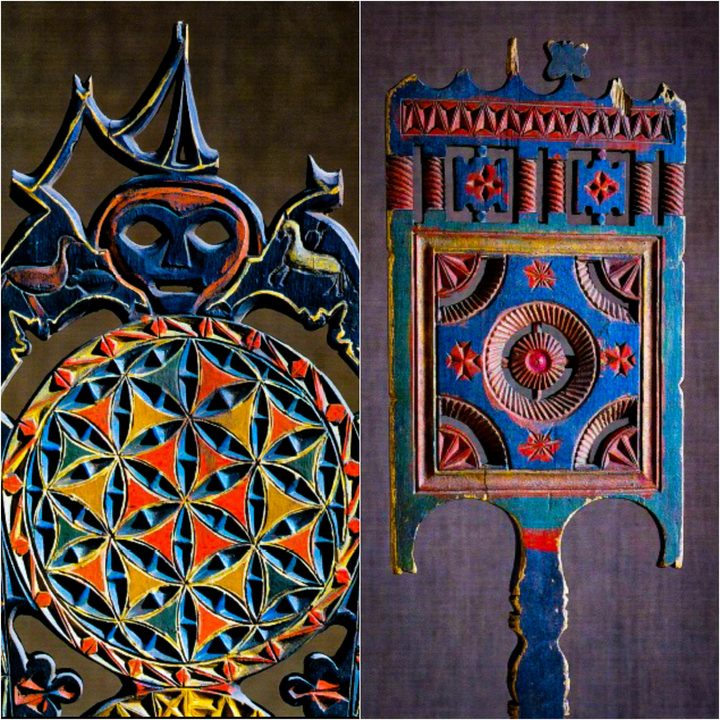
Fretwork on distaffs
All types of carving have always demanded experience from the carver. We use these techniques in our work to decorate our pieces and to make them more expressive.
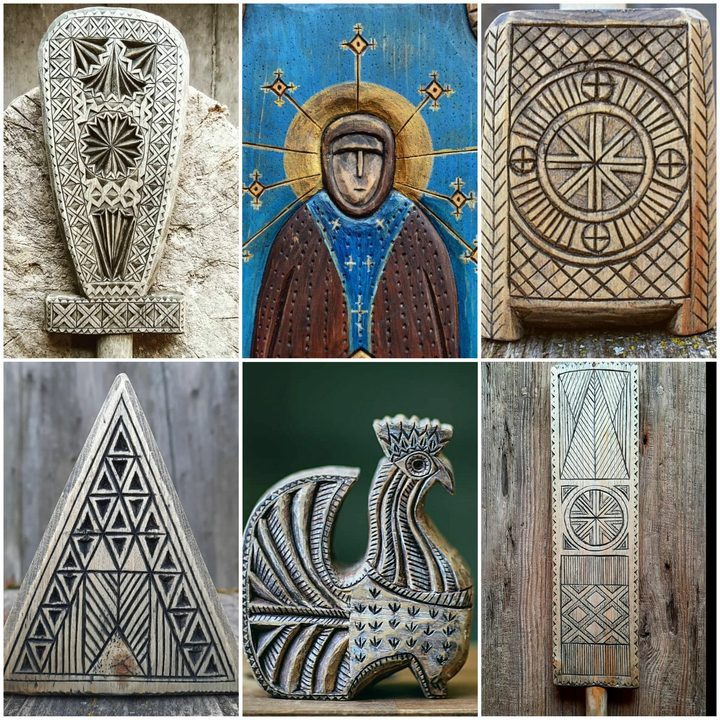
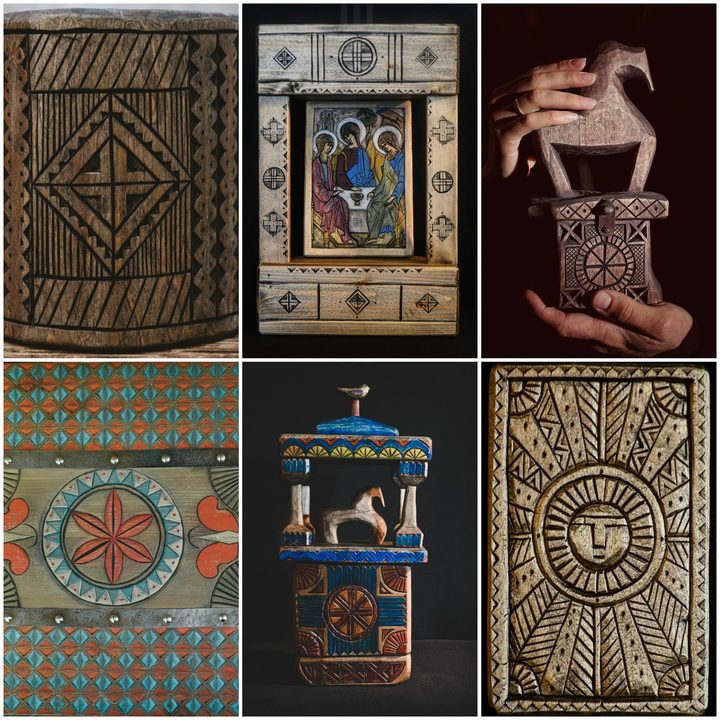
Carved wooden pieces made in our workshop
Sources (in Russian)
- Voronov V.S. “Folk Carving” (1925)
- Taranovskaya N.V. “Russian Distaffs” (2001)
- Boguslavskaya I.Ya. “Russian Folk Art” (1984)
- Kruglova O.V. “Russian Folk Carving and Painting on Wood” (1983)