Working with Wood. A History
Yuri Bezobrazov · · 5 min read
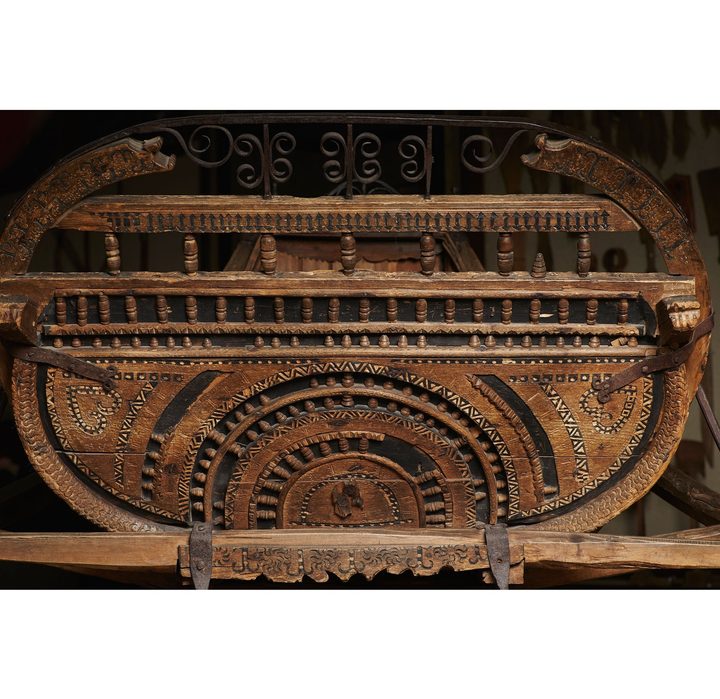
In the 21st-century world, when anything can be made of plastic and life in a high-rise seems normal and familiar to 75% of Russia's population, it is hard to imagine that only a century ago the world around a Russian person was completely different, and its main material was wood.
We are starting a series of articles on the culture of village life, the beliefs of the peasants and, of course, wooden objects: from toys to the decoration of peasant houses.
Everyone had to work with wood and do carpentry: it was not the lot of a few craftsmen. Until the 19th century every peasant family built its own house or made its own furniture. In the towns the situation was different. Everything was made of wood: from houses and churches to boats, from furniture to utensils. Work on such a scale required special craftsmen — carpenters and joiners. In the old days carpenters were called drevodely, and joiners tesli or teslyari. A carpenter who worked on large buildings could be called a gorodnik or ogorodnik. The craftsmen's work has survived especially well in Veliky Novgorod, Sviyazhsk and Staraya Ladoga: here archaeologists have found fragments of houses and roadways, tableware, toys and much more.
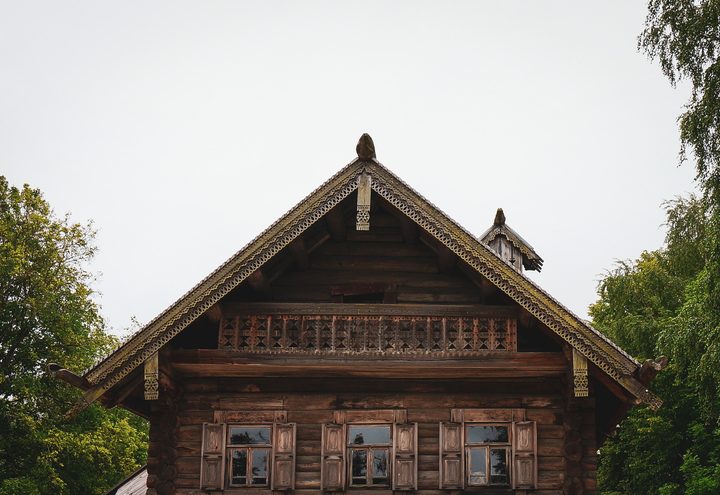
The façade of a house museum in the village of Vitoslavlitsy
In villages and towns alike, a traditional set of tools was used: the axe, the adze, the spoon gouge and the drawknife. The axe (sekira, as the tool itself was called) was the main tool, and the saw was used mainly in towns and only for small joinery. The adze was also used for woodwork: an axe with a blade perpendicular to the handle, like a hoe. It had to be worked with both hands, so it was better suited for hollowing out large objects: boats or troughs. For fine work in towns the chisel was used more often — a sharp iron rod for punching holes. Other tools were used too, such as the spoon gouge — a long iron rod with a curved spear-shaped end, used to cut and scrape out the inside of wooden vessels. The drawknife was a straight or curved knife with handles at the ends, used to strip bark from logs. In towns, besides all this, drills, chisels, knives, hammers and even lathes were used.
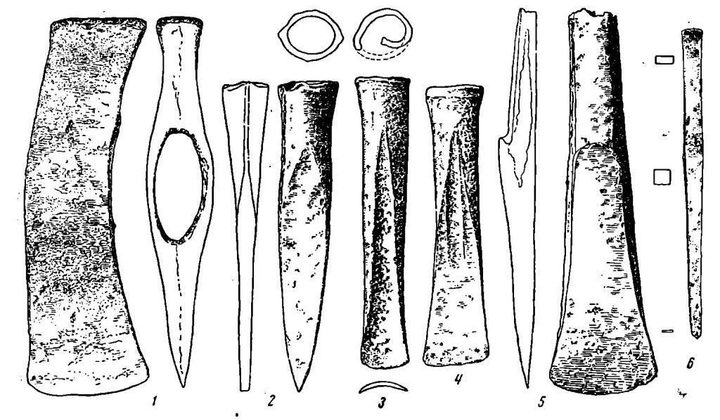
1 – Bronze axe. Length 16 cm, width 4.3 cm; 2–4 – bronze chisels; 5 – bronze wedge-shaped adze with a tang for hafting, one side flat, the other with a projection at the tang; 6 – bronze four-sided double-ended chisel, thickened in the middle (V.I. Moshinskaya, 1957).
The choice of wood was very important. Mainly pine, lime, spruce and birch were used. The first two were preferred: pine was common in the north and lime in central Russia. Pine is durable, with long fibres, and when worked it gives a clean, smooth surface. Soft lime was chosen: this was the wood suited to the lavish Baroque iconostases that became popular in the 18th century. Gradually aspen and alder came into use alongside lime. When choosing material for a building or utensils, people were guided not only by the properties of the wood but also by religious considerations. In the Vologda region, for instance, it was once believed that if you cut down a lime tree you would surely get lost in the forest. Sacred groves and sacred trees are mentioned all over Russia.
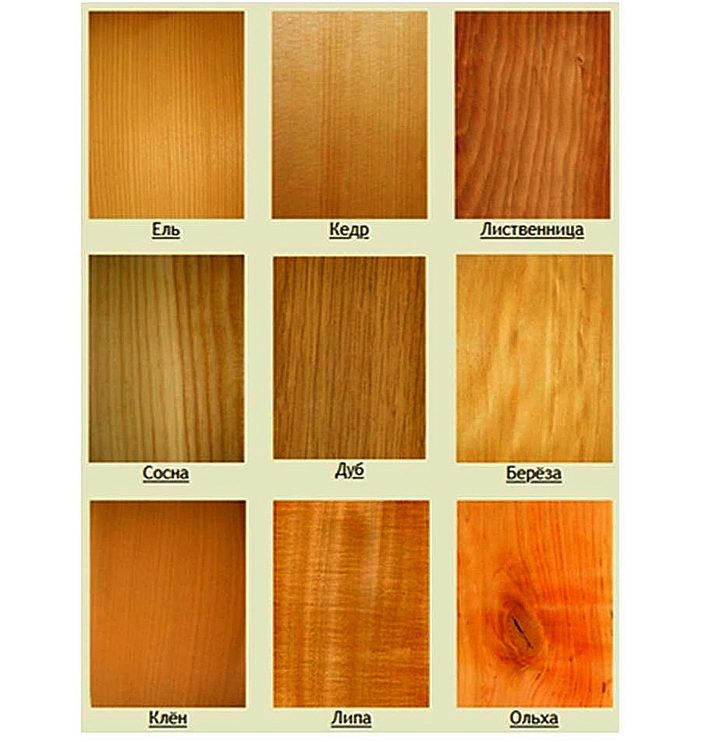
The texture of the coniferous and deciduous trees common in the north and in central Russia
Masters did not work with green wood: a felled tree was stripped of almost all its bark, the ends of the trunk were sealed with resin, and it was left to dry. This preparation guaranteed that after several years the material would have neither cracks nor deformations.
Many objects were richly decorated with carving. Among the oldest surviving monuments (14th–15th centuries) are gates and crosses. The oldest is the Lyudogoshcha Cross (1359).
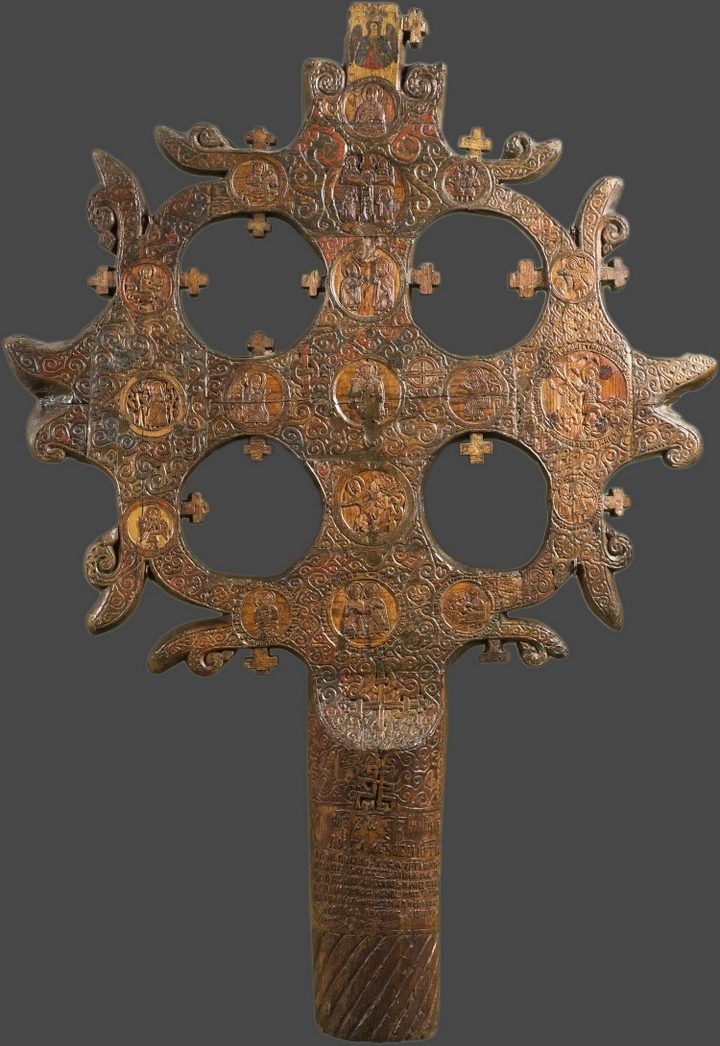
The Lyudogoshcha Cross
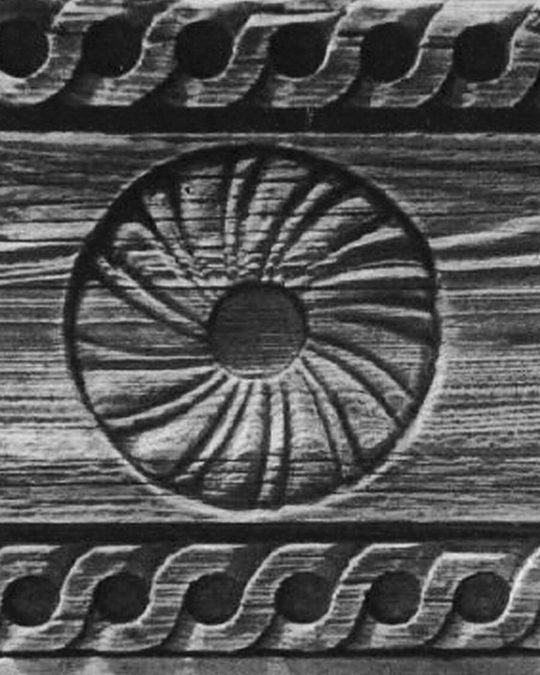
Carving could be pierced (openwork) or raised against an even, smooth background — “blind” or “hollowed”. For blind carving a design was drawn on a smooth board, cut along the contour and the background (“ground”) was removed: this is how volume was born. Depending on the depth and angle of the cut, the work seemed more sculptural or played more clearly at a distance thanks to light and shade. Carved boards were often painted in bright colours: blue, green, red, yellow, white. This brightness added charm to the houses, especially against dark roofs and silvery logs.
Carving repeated the same motifs as objects of bronze and silver. Among the ornaments were interlacing, rosettes and sometimes snow leopards and birds. The roots of the symbolism are to be sought in pagan beliefs, but it changed over time and lost its original meanings. Gradually carving became merely beautiful decoration, and wood was replaced by cheaper materials.
In the 21st century it is ever harder to restore this art, already forgotten by many. Our workshop makes and revives the wooden toys and household objects of the Russian North. We continue our family's work, using the same material as our great-grandfather at the beginning of the 20th century. Once again we speak to you through form and carved patterns in wood, reflecting the character of folk culture and history in our pieces.
Sources (in Russian)
- Desyatnikov V.A. “Russian Wooden Sculpture” (1972)
- Moshinskaya V.I. “The Balandino Hoard of Bronze Tools” – KSIIMK, issue 67 (1957)
- Rybakov B.A. “The Crafts of Ancient Rus” (1948)
- Sobolev N.N. “Russian Folk Woodcarving” (1984)
- Chekalov A.K. “Folk Wooden Sculpture of the Russian North” (1974)